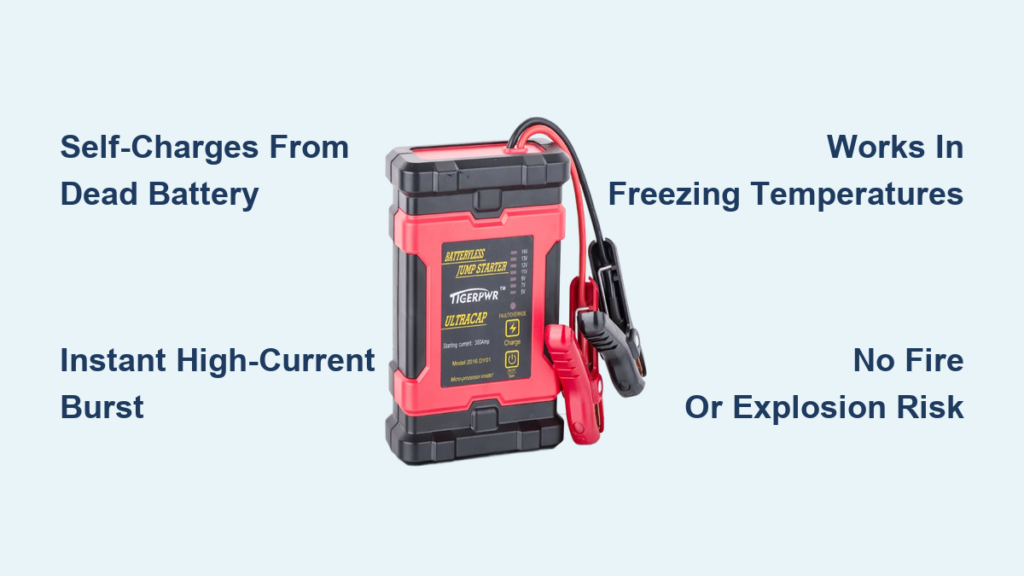
Picture this: freezing morning, dead battery, and no second car or wall outlet in sight. With a capacitor jump starter, you can still get moving in minutes because the device charges itself from your dying battery and fires the engine instantly. No lithium cells, no fire risk, no waiting hours for a recharge.
In this guide, you’ll learn exactly how a capacitor jump starter works, from the supercapacitor technology inside to the step-by-step starting process. We’ll also cover charging speeds, cold-weather performance, real-world test results, and the limitations you should know before buying.
Supercapacitor vs. Battery: The Core Difference
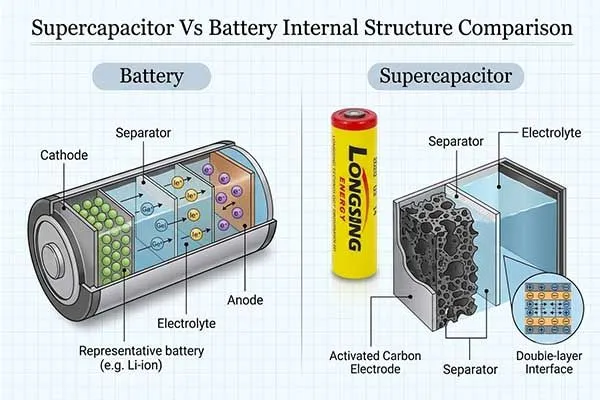
Electrostatic Storage Instead of Chemical Reactions
A capacitor jump starter stores energy electrostatically inside supercapacitors, sometimes called ultracapacitors. Two conductive plates separated by an insulator hold a charge, similar to static electricity but on a much larger scale. Chemical batteries like lithium-ion or lead-acid generate power through internal reactions instead.
Because no chemical process is involved, there is nothing to degrade. That single difference explains most of the advantages these devices offer over traditional jump packs.
No Chemical Degradation Over Time
Lithium jump starters typically lose capacity after 500 to 1,000 charge cycles and often fail within 2 to 3 years due to swelling or chemical breakdown. Supercapacitors endure up to 500,000 cycles with minimal loss, giving a capacitor jump starter a lifespan of 10 years or more.
• Lithium jump starter: 2–3 years, 500–1,000 cycles
• Capacitor jump starter: 10+ years, up to 500,000 cycles
One forum user owned five lithium jump starters between 2014 and 2017, and every unit failed within three years from battery expansion and casing rupture. Capacitor models are investments, not consumables.
Instant Charge and Discharge
Supercapacitors charge and discharge in seconds, not hours. A lithium pack may need 3 to 6 hours to recharge, while a capacitor unit refills from a weak battery in under 3 minutes. That speed matters most when you’re stranded.
How It Delivers Power: Step-by-Step Operation
Connect and Activate
Follow this sequence every time:
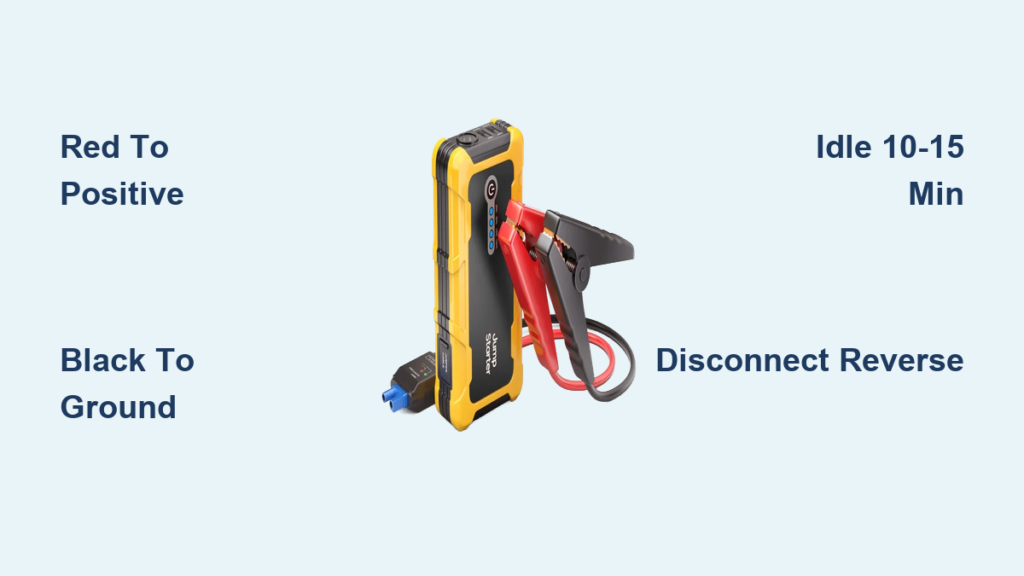
- Connect the red clamp to the dead battery’s positive terminal
- Connect the black clamp to the negative terminal
- Press the power button to activate the unit
- Wait for the countdown to finish
- Crank the engine, then disconnect the clamps
If the battery voltage is below 6V, many models will not auto-start, so manual activation is required.
Countdown Before Cranking
After activation, the device runs a 6 to 10 second countdown while the supercapacitor builds enough charge for a high-current burst. An LED or LCD display shows charge level, and an audible beep confirms readiness. Do not crank early. In one documented test, a user tried starting at 99% charge and got no response at all.
High-Current Burst Delivery
At the end of the countdown, the capacitor releases a surge of power directly to the battery. Models like the Keen Power SC6000 deliver up to 6,000 amps peak, with a burst lasting up to 25 seconds. That is enough to crank even large engines, and the power arrives instantly with no warm-up delay.
Self-Charging from a Dead Battery: The Game-Changer

Draw Power from a Weak Battery
The standout feature of a capacitor jump starter is its ability to charge itself from a nearly dead battery. If the battery still holds at least 1 volt, the supercapacitor pulls energy from it, stores that energy, and then uses it to start the engine. No outlet, no second car, no USB charger needed.
Real-World Proof: Cummins Diesel Start
In a documented test, the Keen Power SC6000 revived a completely dead 6.7L Cummins diesel in near-freezing temperatures. The unit charged from the dead battery in 3.5 minutes, then started the truck, and repeated the feat a second time using only energy drawn from that same dead battery.
Voltage Thresholds That Matter
• Below 6V: The device will not auto-turn on; press the power button manually
• Below 1V: The device will not respond at all
• 6V and above: Normal auto-on operation works
If the unit stays unresponsive after pressing the button, the battery is too dead. You’ll need to charge the jump starter from an external source first.
Charging Methods and Speed
Fast Recharge from Any 12V Source
• From a car battery (good or weak): under 3 minutes
• From a cigarette lighter socket: under 5 minutes
• From another car’s battery: under 3 minutes
• Via USB (5V): 10 to 45 minutes depending on model
Even a mobile power bank can top up the unit in under 30 minutes, enough for emergency use.
USB-C and Micro-USB Inputs
Newer models like the AutoWit SuperCap2 add USB-C charging, making it easier to recharge from modern power banks. USB is slower than a 12V source, but it guarantees you can top up anywhere on the road.
Cold Weather Performance Advantage
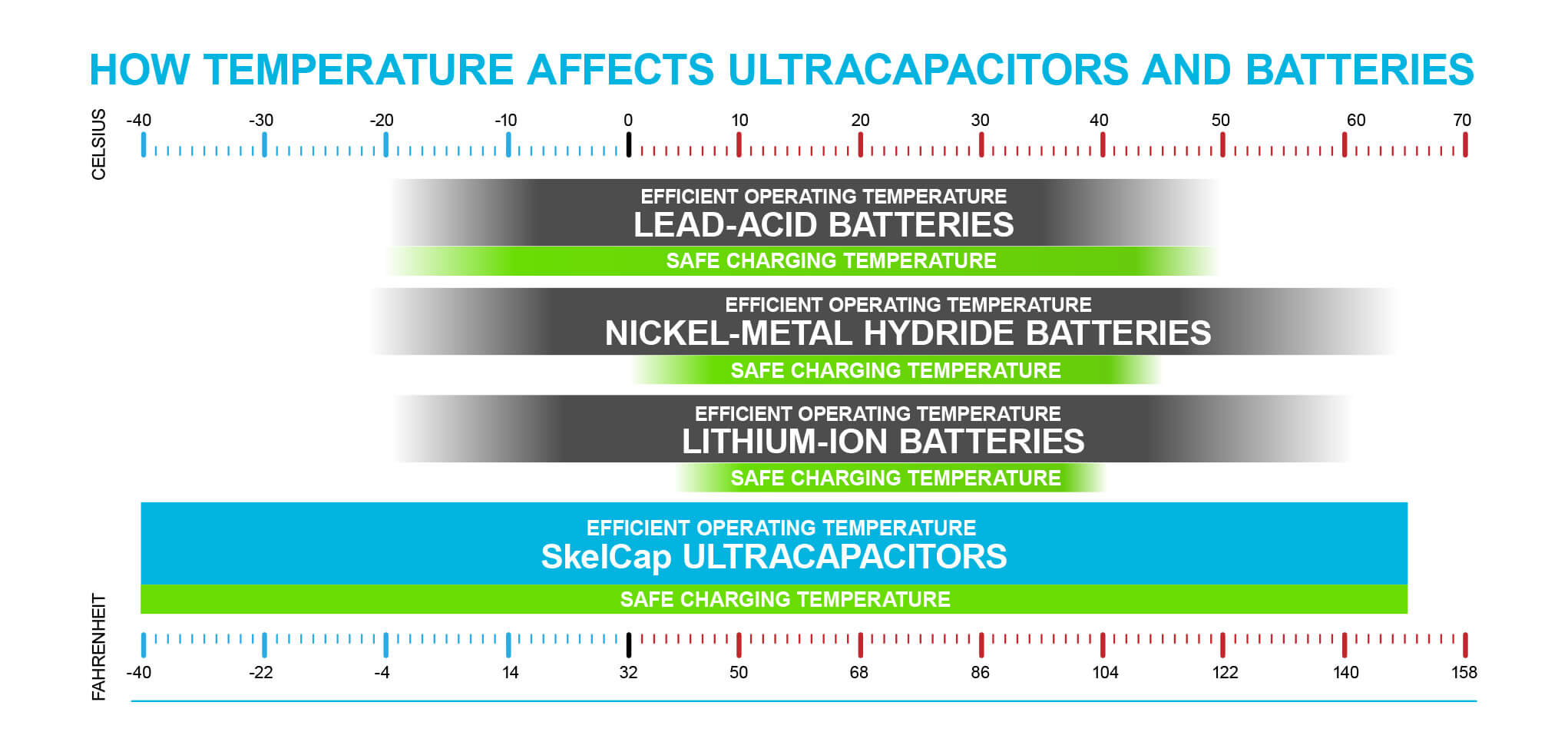
Works Better When Temperatures Drop
Chemical batteries slow down in the cold because their internal reactions become sluggish. Supercapacitors have no chemistry to slow down, so they actually perform better in freezing conditions.
Proven in Extreme Cold
• A DBPower unit worked reliably at 15°F
• The Keen Power SC6000 started a Cummins diesel in near-freezing weather
• No performance drop appeared in any documented cold test
That makes capacitor jump starters ideal for winter drivers, off-roaders, and anyone in northern climates.
Engine Compatibility and Limitations
Best for Petrol and Smaller Engines
Capacitor jump starters excel with petrol engines and smaller vehicles. The Autowit SuperCap2 started a Toyota Tacoma whose battery was so dead the headlights and flashers wouldn’t even turn on.
Diesel Engine Caution
Expert Scotty Kilmer warns against using these units on diesel engines because glow plugs draw high current during startup, draining the supercapacitor too quickly. That said, the SC6000 and DBPower units have both started diesel trucks successfully, so results depend on engine size and temperature.
Safety and Design Advantages
No Fire or Explosion Risk
With no lithium-ion battery onboard, there is zero risk of thermal runaway, swelling, or fire. Supercapacitors are solid-state, contain no hazardous chemicals, and their components are fully recyclable.
Built-In Safety Protections
• Reverse polarity protection so reversed clamps won’t activate the unit
• Short circuit protection
• Overcharge protection
• Audible and visual alerts for system status
These features make capacitor jump starters safe even for first-time users. Without heavy battery cells, most units fit easily in a glove box.
Real-World Performance Data
Harley Motorcycle Test
An Autowit SuperCap2 faced a Harley battery at 11.4V. The unit charged in about 3 minutes but paused at 99%, and a start attempt failed. Only after reaching 100% and completing the 10-second countdown did the engine fire easily. Full charge and proper timing matter.
Dead SUV Battery Test
A family’s SUV battery read just over 8 volts. The unit charged from it, the OK LED turned green, and the engine turned over strongly, even though the driver cranked too early without letting gauges settle.
Cummins Diesel Test
In freezing conditions, the SC6000 charged from a dead battery in 3.5 minutes, started the truck after a 5-second glow plug warm-up, and then did it again using only self-charged energy.
Troubleshooting Common Issues
Device Won’t Turn On
- Check battery voltage; if below 6V, press the power button manually
- If still unresponsive, the battery is below 1V; charge the unit externally first
- Confirm both clamps are securely connected
Engine Doesn’t Start
- Wait for 100% charge, never attempt at 99%
- Let the countdown finish before cranking
- Turn off all vehicle electronics before connecting
- For diesels, allow about 5 seconds of glow plug warm-up
Slow Charging
- Use a 12V source for the fastest recharge
- Save USB charging for emergencies only
- Try self-charging mode if the dead battery holds at least 1V
Frequently Asked Questions About Capacitor Jump Starters
Can a capacitor jump starter charge itself from a dead battery?
Yes. If the battery holds at least 1 volt, the supercapacitor draws power from it, stores that energy, and uses it to start the engine. The Keen Power SC6000 demonstrated this by starting a dead Cummins diesel twice with no external power source.
How long does a capacitor jump starter last?
Manufacturers claim a minimum 10-year lifespan with up to 500,000 charge cycles. One Autowit unit worked perfectly on first use after nearly 5 years in storage.
Do capacitor jump starters work in cold weather?
Better than any battery-based unit. Supercapacitors have no chemical reactions to slow down, so they deliver full power in freezing temperatures. A DBPower unit worked well at 15°F.
Can I use a capacitor jump starter on a diesel engine?
It depends. Scotty Kilmer advises against it because glow plugs drain the supercapacitor quickly. However, the Keen Power SC6000 and DBPower units have both started diesel trucks successfully in real tests.
Does a capacitor jump starter work as a power bank?
Most models do not. The DBPower unit is a notable exception, offering USB output for charging phones and tablets during camping trips.
What happens if my battery is below 1 volt?
The device will not respond at all. You must first charge the jump starter from an external source such as another car, a cigarette lighter socket, or a USB power bank.
Key Takeaways: How a Capacitor Jump Starter Works for Your Vehicle

A capacitor jump starter stores energy electrostatically in supercapacitors, delivering instant high-current bursts, recharging in minutes, and performing better in cold weather than any lithium pack. Its ability to self-charge from a weak battery means you can get started even with no external power available.
Remember the two big limitations: batteries below 1V are beyond its reach, and diesel engines with heavy glow plug draw may drain it too fast. For petrol engines, cold climates, and drivers who want a maintenance-free backup that lasts a decade, the technology is hard to beat.
If you’re ready to stop worrying about dead batteries, check out models like the AutoWit SuperCap2 or Keen Power SC6000 and keep one in your glove box before your next cold snap.