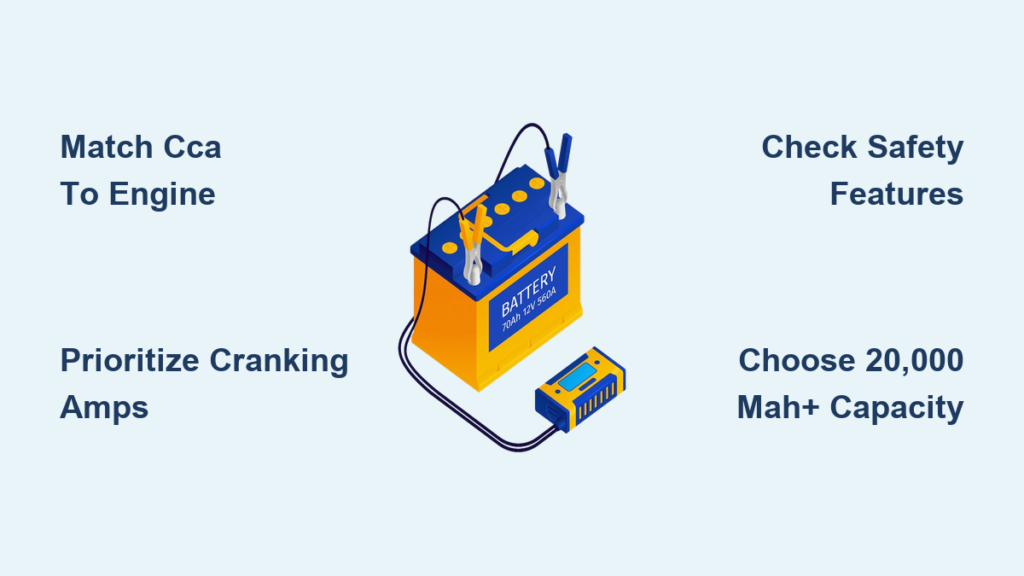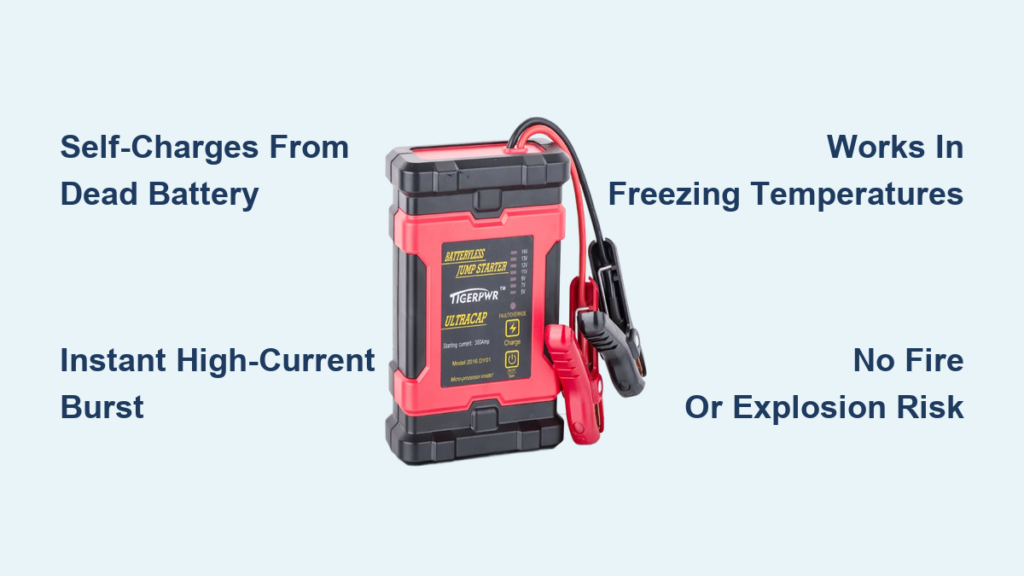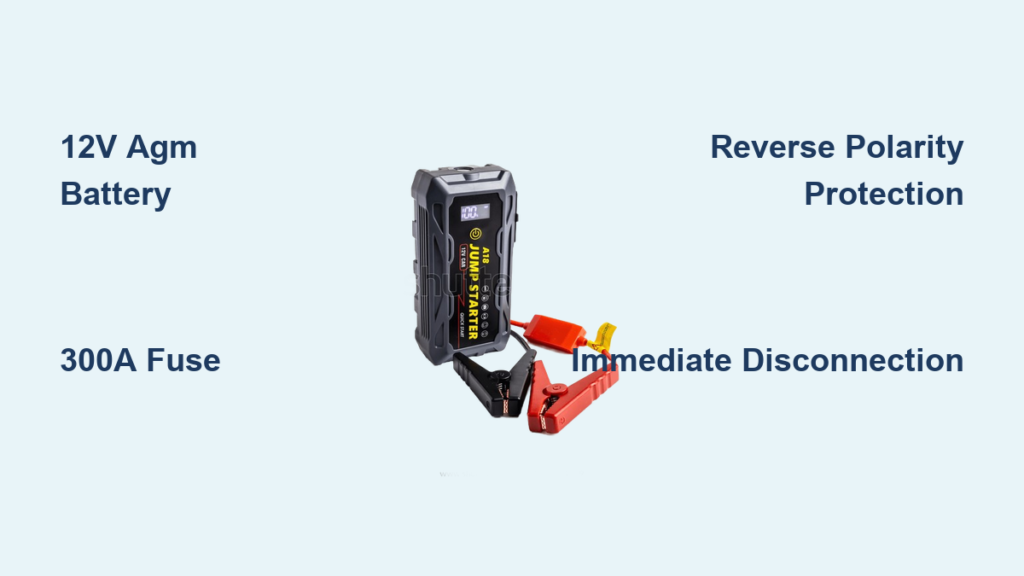
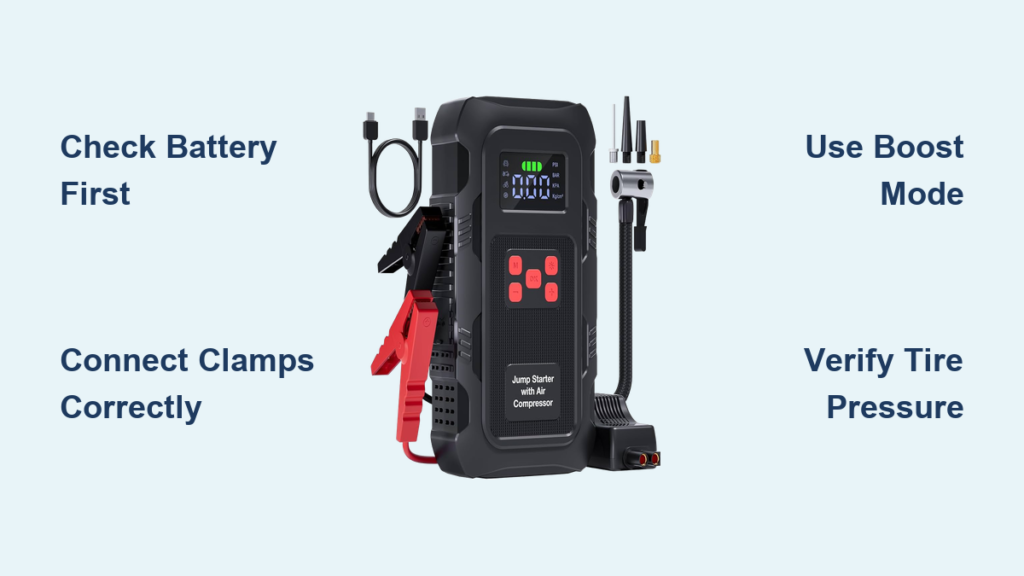
A dead battery or flat tire always seems to happen at the worst moment. Instead of carrying two separate tools, a jump starter with air compressor handles both emergencies in one compact device you can store in your glove box.
This guide walks you through every step of using a jump starter air compressor safely. You’ll learn how to jump-start your car, inflate tires with precision, read indicator lights, avoid common mistakes, and keep your device ready for years of reliable service.
Jump Start Your Car Safely with Smart Clamps
Starting a dead engine is the main job of any jump starter. Doing it wrong risks damage to your vehicle or injury, so follow these steps carefully every time.
Inspect the Battery Before Connecting Anything
Look over the car battery first. Do not attempt a jump start if you notice:
• A cracked, swollen, or leaking battery case
• A rotten egg smell, which signals sulfur gas
• A frozen battery, common in winter
Damaged batteries can release hydrogen gas that ignites easily from a single spark. If you spot any of these warning signs, stop and call a professional instead.
Connect the Clamps in the Correct Order
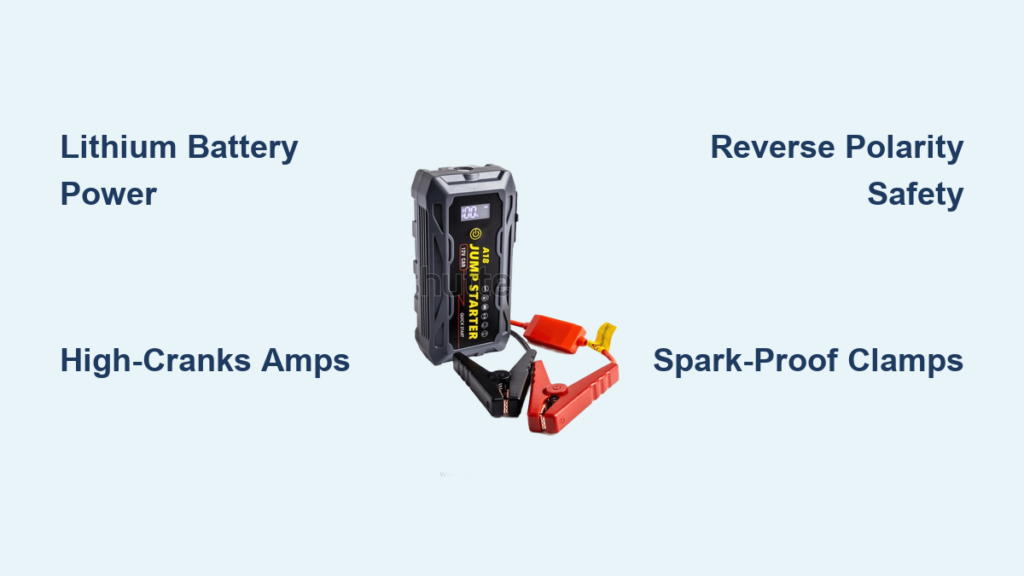
Most modern units use smart clamps with reverse-polarity protection. Connect them like this:
- Power on the jump starter and confirm it has enough charge.
- Plug the clamp cable into the output port on the unit.
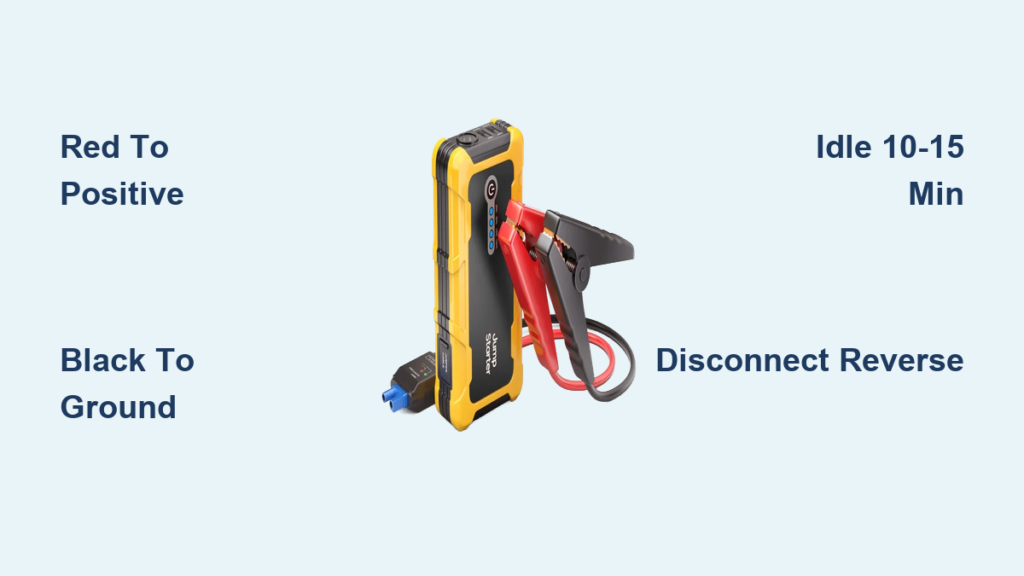
- Attach the red clamp to the battery’s positive (+) terminal.
- Attach the black clamp to a clean, unpainted metal surface such as the engine block, away from fuel lines and moving parts.
⚠️ Warning: On some models like AutoOne, never connect the black clamp directly to the negative terminal. This can create dangerous sparks.
Keep both clamps clear of belts, fans, and hot engine parts throughout the process.
Read the Indicator Lights Correctly
After connecting, check the indicator light or display:
• Steady green light: Connection is correct. Start the engine now.
• Steady red light: Polarity is reversed. Swap the clamps and try again.
• Flashing green light: Battery voltage is too low. Use the boost function.
• No lights: The battery may be completely dead. Press and hold the Boost button until the green light stays on.
If the unit beeps or flashes, recheck your connections before moving forward.
Start the Engine and Disconnect in Reverse
Once you see a steady green light, turn the key or press the start button. Most engines fire up within seconds. If the engine doesn’t turn over, wait 30 to 60 seconds before trying again. Never hold the start attempt longer than 5 seconds at a time.
After the engine runs, disconnect in this order:
- Turn off the jump starter.
- Remove the black (negative) clamp first.
- Remove the red (positive) clamp second.
This reverse removal order prevents accidental short circuits.
Use Boost Mode for Completely Dead Batteries
Some batteries are so drained they won’t trigger a normal start. The boost function solves this problem.
On WOLFBOX MegaVolt models, press and hold the Boost button until the green light stays on, then start the car within 30 seconds. This mode delivers extra power to overcome extremely low voltage, making it possible to start a completely dead battery.
Inflate Tires with Precision Using the Built-In Compressor
Underinflated tires hurt fuel economy, handling, and safety. Your jump starter air compressor lets you fix low tires right at the roadside in just a few minutes.
Select the Right Inflation Mode
Press the Mode (M) button to cycle through preset options:
• Car
• Motorcycle
• Bicycle
• Basketball
• Custom
Each mode loads a default pressure. Car mode typically sits around 32 to 35 PSI, while bicycle mode ranges from 40 to 65 PSI. Switch to Custom mode whenever you need a specific pressure value.
Set Your Target Pressure
- Use the + and – buttons to adjust the target PSI.
- Check your vehicle’s recommended pressure on the driver’s door jamb or in the owner’s manual.
- Never exceed the maximum PSI printed on the tire sidewall.
You can also switch pressure units by holding the mode button. Options include PSI, BAR, KPA, and kg/cm2.
Start Inflation and Let Auto-Stop Work
- Remove the valve cap from the tire stem.
- Attach the hose nozzle firmly until you hear it click into place.
- Press and hold the power button to begin inflation.
The digital display shows real-time pressure on the top line and your target pressure on the bottom line. When the tire reaches the set pressure, the compressor stops automatically.
Verify the Final Pressure
Even with auto-stop, always double-check with a separate tire gauge before replacing the valve cap. Digital sensors can drift slightly over time.
If pressure runs too high, press the bleed button if your model has one, or briefly press the valve stem core with a tool. Repeat for each tire and monitor the unit’s battery level during multiple inflations.
Pro Tip: A MegaVolt 10Air inflates a standard 195/65 R15 tire from 29 to 36 PSI in about 1 minute. Larger pickup tires take roughly 2.5 to 3 minutes.
Master the Control Panel and Display
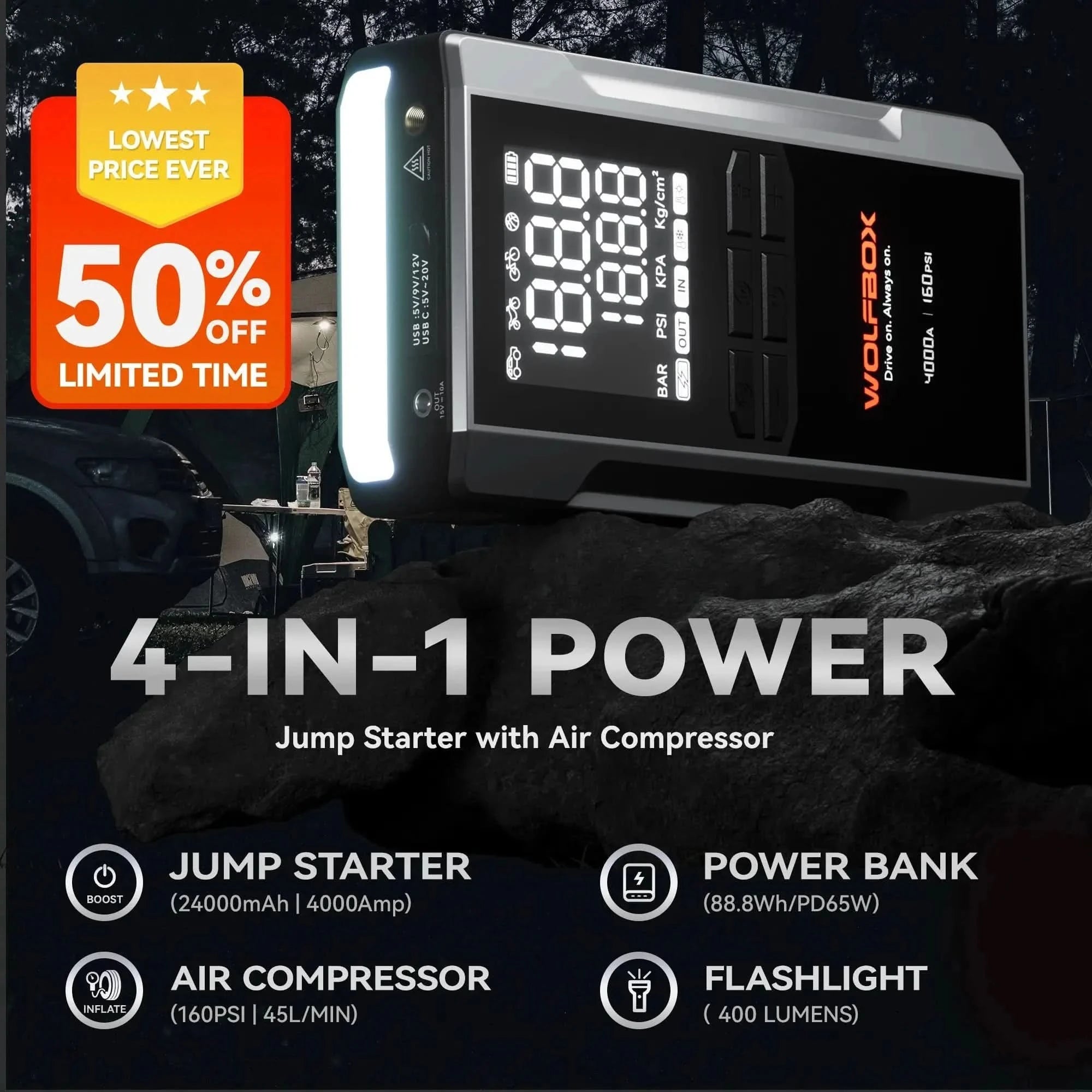
Knowing your device’s buttons prevents confusion during a roadside emergency.
AutoOne Control Functions
• Power button: Turns the unit on and off and activates the flashlight.
• Mode button: Cycles through inflation presets.
• Hold mode button: Switches between PSI, BAR, KPA, and kg/cm2.
• + / – buttons: Adjust the target pressure.
• Flashlight modes: One press for steady light, two presses for SOS, three presses for strobe.
WOLFBOX Display Features
The LCD screen shows battery level, real-time pressure, target pressure, and charging status. Watch for the “IN” indicator, meaning the unit is charging, and the “OUT” indicator, meaning it is powering another device such as your phone.
Charge Devices and Use Emergency Lighting
Your jump starter air compressor doubles as a full emergency power station.
Charge Phones and Tablets
Use the USB-A or USB-C ports to charge smartphones, GPS units, or tablets. Output reaches up to 2.4A on some models. Keeping your phone charged lets you call for help or navigate when stranded. Just confirm the unit has enough charge before plugging in.
Use the LED Flashlight at Night
Built-in LED lights offer three useful modes:
• Steady: For working under the hood or changing a tire
• SOS: Sends a universal distress signal
• Strobe: Increases your visibility to passing traffic
Press the power button repeatedly to cycle through modes. This feature is invaluable during nighttime breakdowns.
Avoid These Common Jump Starter Air Compressor Mistakes

Even experienced drivers make errors that waste time or create hazards. Watch out for these problems.
Prevent Reverse Polarity Connections
Connecting red to negative and black to positive triggers the reverse-polarity alarm. Safety circuits prevent damage, but the mistake costs time during an emergency. Always double-check that red goes to positive and black goes to negative or ground before starting.
Never Overinflate Your Tires
Auto-stop helps, but an incorrect setting can still overinflate a tire. A tire pushed beyond its sidewall rating faces a serious blowout risk, especially at highway speeds. Set pressure based on the vehicle’s recommendation, verify with a standalone gauge, and stop immediately if the tire feels hot, bulges, or hisses abnormally.
Recharge After Every Use
Lithium batteries lose charge over time even when idle. Recharge the unit as soon as possible after any use, typically via USB-C in about 4.5 hours. Leaving it drained shortens battery life and may trigger safety locks.
Store Within Safe Temperature Limits
Most units tolerate storage temperatures from -4°F to 140°F (-20°C to 60°C). Avoid leaving the device in direct sunlight on a dashboard, and keep it out of a freezing trunk in winter. Extreme temperatures accelerate battery aging.
Maintain Your Device for Long-Term Reliability
A well-maintained jump starter air compressor lasts years and works when you need it most.
Recharge Every 1 to 2 Months
Lithium-ion batteries self-discharge at roughly 5 to 10% per month. Recharge the unit every 30 to 60 days, even if you never use it. Setting a calendar reminder keeps the battery healthy and ready.
Test Before an Emergency Hits
Every few months, power on the unit to check the battery level, test the clamps and indicator lights, and run the compressor for about 10 seconds. This quick check confirms everything works before you actually need it.
Store It Properly
Keep the unit in its storage case in the glove compartment or under a seat. Avoid damp areas and spots with heavy vibration.
Troubleshoot Errors Fast
Quick diagnosis saves precious time when something goes wrong.
Red Light on the Clamps
Cause: Reverse polarity.
Fix: Swap the red and black clamps, then wait for the green light before trying again.
Green Light Flashing
Cause: Battery voltage is too low.
Fix: Press and hold the Boost button until the green light stays on, then start the car within 30 seconds.
Compressor Won’t Start
Check three things: the hose attachment, the battery level, and whether the target pressure is already met. If the unit shuts off mid-inflation, it may be overheating. Let it cool for 5 to 10 minutes before retrying.
No Display or Power
Confirm the unit is charged and hasn’t been stored in extreme cold. Plug it in and charge for at least 30 minutes. If it remains unresponsive, contact the manufacturer.
Frequently Asked Questions About Using a Jump Starter Air Compressor
Can I jump start a completely dead battery?
Yes. Modern lithium jump starters like the WOLFBOX MegaVolt series include a boost function designed for severely low voltage, including completely dead batteries. Hold the Boost button until the green light stays on, then start the car within 30 seconds.
How long does it take to inflate a tire?
It depends on the model and tire size. Most WOLFBOX units inflate a standard passenger tire in about 1 minute and a larger pickup or SUV tire in 2 to 3 minutes, thanks to preset pressures and auto-stop.
Can I leave the unit in my car in summer or winter?
Yes. Most units are rated for storage from -4°F to 140°F, which covers typical glove compartment and trunk conditions year-round. In extremely hot climates, choose shaded storage.
How do I know when the unit is charging?
The LCD screen displays charging status. An “IN” indicator means the unit is charging, while an “OUT” indicator means it is powering another device such as a phone or tablet.
Why won’t my compressor start?
Check that the hose is fully attached, the battery has charge, and the target pressure isn’t already reached. If the unit shut off during inflation, overheating is likely. Let it cool for 5 to 10 minutes.
Which clamp do I remove first after starting the engine?
Always remove the black (negative) clamp first, then the red (positive) clamp. This reverse order prevents accidental short circuits.
Key Takeaways for Using Your Jump Starter Air Compressor
Mastering your jump starter air compressor comes down to three habits: inspect the battery before connecting, follow the clamp order carefully, and trust the auto-stop feature while verifying pressure with a separate gauge. Safe technique protects both you and your vehicle.
Maintenance matters just as much as technique. Recharge the unit every 30 to 60 days, test it periodically, and store it within the rated temperature range. These simple routines ensure the device works the moment you need it.
Your next step: take five minutes today to power on your unit, check the charge level, and run the compressor briefly. A jump starter air compressor is only as reliable as your preparation, and a quick test now guarantees peace of mind on every drive.