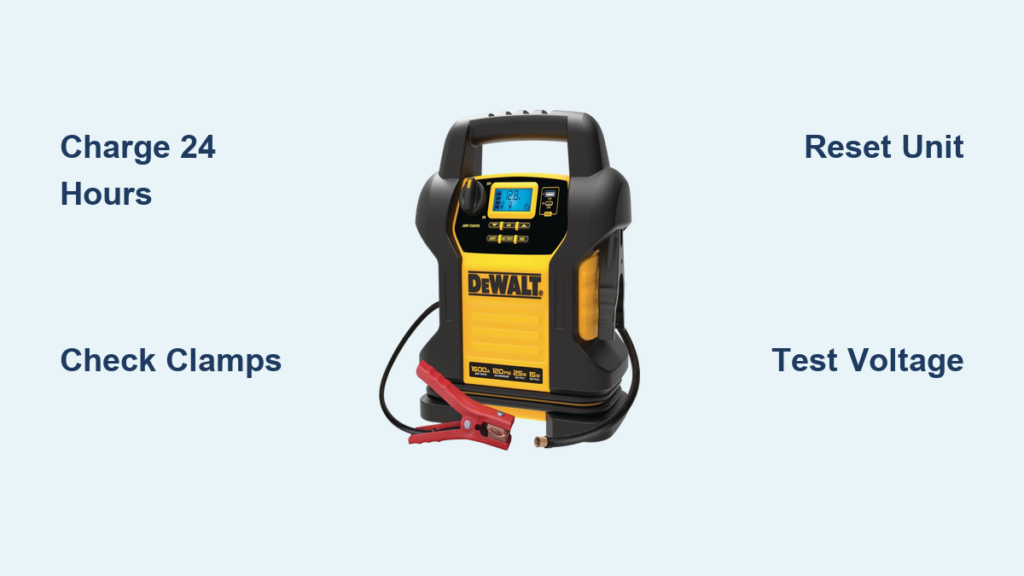
You plug in your DeWalt jump starter, expecting it to recharge fully overnight—only to find it stuck at 12.1 volts the next day. The charging light glows, but the battery never reaches full capacity. If your DeWalt jump starter is not charging, you’re not alone. This issue is common, especially after long periods of inactivity. Many users report the same problem after leaving their unit unused for months or even over a year.
The root cause? Battery degradation from prolonged storage without maintenance. Whether your model has lead-acid or lithium-ion batteries, all batteries self-discharge over time. Without regular top-offs, they can fall into a deep discharge state that prevents proper charging. But here’s the good news: in most cases, this isn’t a death sentence. With the right diagnostics and a few simple fixes—like warming the unit, testing voltage, or replacing internal batteries—you can often restore full function. This guide walks you through every step to diagnose, troubleshoot, and fix your DeWalt jump starter not charging.
Test Charging Voltage at the Terminals

Before replacing parts, confirm whether your DeWalt jump starter is actually receiving charge.
Measure Voltage While Plugged In
Use a multimeter to check the voltage at the battery terminals while the unit is connected to AC power. A working charging system should output at least 1 volt higher than the resting battery voltage.
- If the battery reads 12.1V at rest, expect 13.1V to 14.5V when charging
- Compare to a car alternator, which typically delivers about 14V when charging a 12V system
If the voltage doesn’t increase significantly when plugged in, the problem may be with the charger or internal circuitry—not just the battery.
Understand How Batteries Affect Readings
A deeply discharged or degraded battery can pull down the charging voltage, making it appear as if the charger isn’t working—even if it is. Always disconnect from AC power before checking the battery’s actual stored voltage. This ensures you’re measuring real charge retention, not just surface voltage under load.
Warm the Jump Starter Before Charging

Cold storage can prevent batteries from accepting a charge, especially if kept in garages or sheds during winter.
Let the Unit Reach Room Temperature
Place your DeWalt jump starter in a warm room (70–75°F / 21–24°C) for 12–24 hours before attempting to charge. Batteries need to warm “all the way through” to function properly.
- Why it works: Cold slows chemical reactions inside batteries, reducing their ability to accept and store charge
- Best for: Units stored in unheated spaces or used in freezing climates
After warming, plug in the unit and monitor voltage over several hours. Some users report successful recovery after this simple step—especially if the battery was only temporarily inhibited by cold.
Verify Actual Battery Charge Level
Charging indicators can be misleading. The display might show activity, but that doesn’t mean the battery is gaining usable charge.
Unplug to Check True Voltage
Leave the jump starter plugged in for 8–12 hours, then unplug it immediately and measure the voltage with a multimeter.
- If voltage remains around 12.1V, the battery is not charging
- A fully charged 12V battery should read 12.6V or higher
This method reveals whether the unit is truly storing energy or just drawing power without retention.
Recognize Signs of Permanent Discharge
A reading of 12.1V or lower after extended charging suggests:
– The battery has sulfated (in lead-acid models)
– It’s entered a permanent low-voltage state
– Internal cells may be damaged
In such cases, even a working charger won’t revive the battery without replacement or intervention.
Replace the Internal Batteries
When diagnostics confirm no charge gain, the internal battery is likely the culprit—and replacement is often the best fix.
Choose the Right Replacement Battery
For DeWalt jump starters with replaceable lead-acid batteries, Mighty Max batteries (available on Amazon) are a popular and cost-effective option:
– Prices range from $40 to $50, depending on amp-hour rating
– Replacing both batteries costs less than half the price of a new unit
After replacement, users report performance equal to a “basically new jump box.”
Follow Safe Replacement Steps
Replacing internal batteries involves opening the case:
1. Power off and unplug the unit
2. Remove screws securing the housing
3. Carefully disconnect old batteries
4. Install new ones with correct polarity
5. Reassemble and test
Pro tip: Label wires before disconnecting to avoid reverse connections.
Some users have even revived old units pulled from dumpsters by adding distilled water to flooded lead-acid cells—a technique that extended life by several years.
Charge Every 90 Days to Prevent Failure
Prevention beats repair. The most effective way to avoid charging issues is regular maintenance.
Set a Quarterly Charging Schedule
Even if unused, top off your DeWalt jump starter every 3 months:
– Plug in for a full 6–8 hour charge cycle
– Verify full voltage (12.6V+) with a multimeter
– Store in a climate-controlled area
Use calendar reminders (Google Calendar, phone alerts) to stay consistent.
Know How Different Batteries Self-Discharge
All batteries lose charge over time:
– Li-ion: Loses ~4–5% per year (modern units)
– LiFePO4: Loses 1–3% per month
– Lead-acid: Can drop below usable levels in 3–6 months
A jump starter stored for over a year without charging is at high risk of irreversible damage.
Upgrade to LiFePO4 for Better Longevity

If you’re replacing batteries, consider upgrading to LiFePO4 (Lithium Iron Phosphate) chemistry for improved lifespan and reliability.
Why LiFePO4 Beats LiIon
| Feature | LiFePO4 | LiIon |
|---|---|---|
| Cycle Life | Thousands | Hundreds |
| Self-Discharge | 1–3% per month | Higher |
| Lifespan | 5+ years typical | 2–4 years |
| Safety | More stable, less fire risk | Higher thermal risk |
LiFePO4 batteries are now preferred in professional jump starters due to their durability and reliability—especially for infrequently used tools.
Consider a Modern Replacement?
If rebuilding seems too involved, consider upgrading to a modern alternative like NOCO or Sears-branded lithium jump starters, which offer:
– Built-in USB ports
– Work lights
– Air compressors
– Better charge retention
Many AAA trucks have already switched to lithium-ion models for their compact size and long shelf life.
Ensure Compatibility for Special Equipment
Some applications require specific features not found on all jump starters.
Need an On/Off Switch for Wood Splitters?
One user relies on their DeWalt to start a wood splitter with no ignition switch. When the jump starter is turned on, it directly engages the starter motor.
- Critical feature: A manual on/off switch that controls power output
- Problem with alternatives: Many modern jump starters only release power when they detect a load (like a car engine cranking)
If you use your jump starter for equipment like wood splitters, lawnmowers, or ATVs, ensure any replacement or rebuild maintains this manual discharge capability.
Store Properly to Avoid Future Issues
Where and how you store your jump starter directly affects battery health.
Keep It Indoors and Dry
Avoid leaving the unit in:
– Unheated garages
– Car trunks in winter
– Humid basements
Cold and moisture accelerate battery degradation. Always bring the unit indoors during off-seasons.
Never Charge a Cold Battery
Never attempt to charge a battery straight from cold storage. Let it acclimate to room temperature first—this can take up to 24 hours depending on size and environment.
Decide: Rebuild or Replace Your Jump Starter?

Choosing between repair and replacement depends on cost, effort, and your needs.
Rebuild If:
- You’re comfortable with basic electronics
- The case opens easily
- Replacement batteries are under $60 total
- You rely on specific features (e.g., manual on/off switch)
Rebuilding restores full function at a fraction of the cost of a new unit.
Replace If:
- The housing is sealed or damaged
- You want modern features (USB-C, faster charging, lighter weight)
- You prefer plug-and-play reliability
Modern lithium jump starters are smaller, lighter, and hold charge longer—ideal for emergency vehicle use.
Frequently Asked Questions About DeWalt Jump Starter Not Charging
Why does my DeWalt jump starter stay at 12.1 volts?
A reading of 12.1V after charging indicates the battery is not accepting or holding a charge. This usually means the internal battery has degraded due to prolonged inactivity or cold storage.
Can a DeWalt jump starter battery be replaced?
Yes, many DeWalt jump starters have replaceable internal batteries. Users commonly replace lead-acid batteries with new ones from brands like Mighty Max, restoring full performance for under $60.
How often should I charge my DeWalt jump starter?
Top off the charge every 90 days, even if unused. All batteries self-discharge over time, and lead-acid types can fail within 6 months of inactivity.
What voltage should a DeWalt jump starter charge to?
A fully charged 12V DeWalt jump starter should read 12.6V or higher. While charging, voltage at the terminals should be 13.1V to 14.5V—at least 1V above resting voltage.
Can cold temperatures prevent charging?
Yes. Cold slows chemical reactions in batteries, making them unable to accept a charge. Always warm the unit to room temperature (70–75°F) for 12–24 hours before charging.
Is it worth rebuilding a DeWalt jump starter?
Yes, if you’re comfortable with basic tools. Replacing internal batteries costs far less than a new unit and can restore like-new performance—especially if you upgrade to LiFePO4.
Key Takeaways for Fixing Your DeWalt Jump Starter Not Charging
If your DeWalt jump starter is not charging, start by testing voltage at the terminals while plugged in and after disconnecting. Most often, the issue stems from battery degradation due to long-term inactivity. Warming the unit, verifying true charge levels, and replacing internal batteries can restore full function.
For long-term reliability, charge every three months and store in a warm, dry place. Consider upgrading to LiFePO4 batteries or a modern lithium jump starter if you want better longevity and convenience. With proper care, your DeWalt jump starter can last for years—even under heavy use.